The Shift in Power: Navigating the New Multipolar Reality
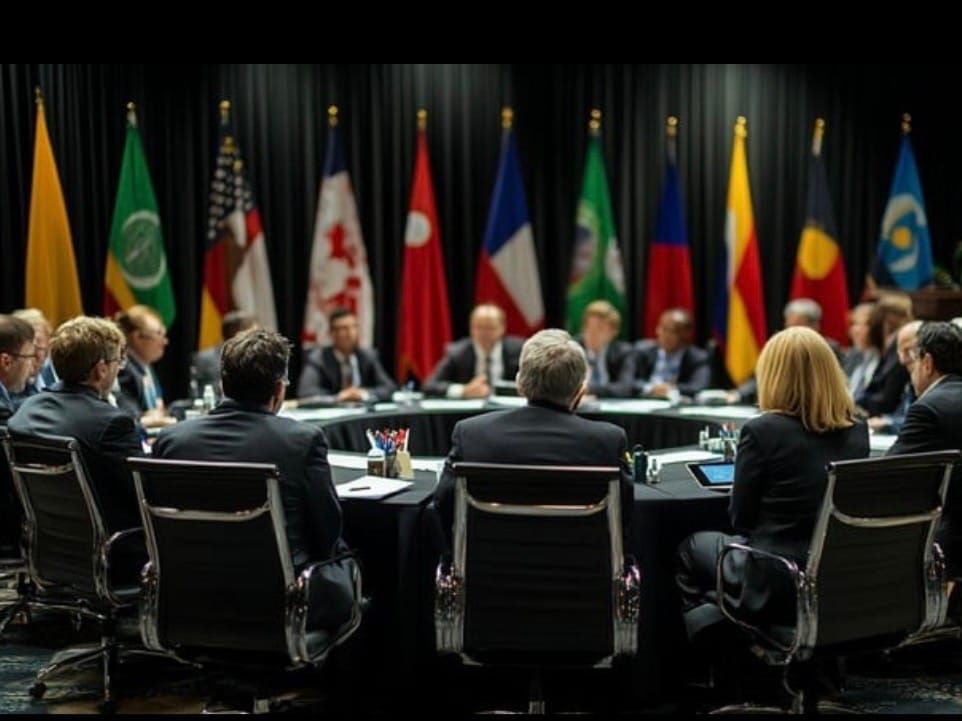
For more than three decades after the Cold War, international politics had a simple organizing principle: one superpower, one set of rules, one center of gravity. That era is over. The defining feature of 2026 is not the rise of a single challenger to the United States, but the simultaneous emergence of multiple centers of power — and the quiet transformation of alliances that were once considered permanent.
The old “status quo” is no longer an accurate lens for viewing global relations. Here is why.
From Hierarchy to Network
The structure of global power is shifting from a hierarchy to a network. According to analysis by the Brookings Institution, Washington in 2026 prioritizes strategic competition with China, alliance-based coordination, and reduced direct involvement in prolonged conflicts — a recognition of the costs of unilateral leadership (Global Power Map 2026).
China, for its part, continues expanding economic and technological reach through infrastructure and trade rather than military confrontation. The Lowy Institute’s Asia Power Index shows Beijing consolidating influence while deliberately avoiding direct conflict — expansion without escalation remains the strategy.
The economic foundation of this shift is hard to dispute. J.P. Morgan’s Center for Geopolitics projects that by 2030, China and India together will generate more than half of global GDP growth (World Rewired report). The global economic center of gravity is moving toward emerging powers — and political weight follows economic weight.
The Rise of the Assertive Regional Power
Perhaps the most consequential change is happening one level below the superpowers. A distinct class of regional great powers — Türkiye, Iran, Saudi Arabia, the UAE, Israel, India, Brazil, Indonesia, South Africa — now acts on its own strategic calculations rather than within a patron’s framework (Foreign Analysis).
The Middle East illustrates the trend. The International Crisis Group notes a strategic realignment marked by reduced reliance on a single external power and deliberate diversification of partnerships. Gulf states buy American weapons, build Chinese-backed infrastructure, and coordinate oil policy with Russia — simultaneously. Chatham House warns that these flexible, transactional alliances add new layers of security complexity: they expand regional maneuverability but make crises harder to predict and contain.
At Davos 2026, the language of middle powers was strikingly uniform. Canada’s Mark Carney put it bluntly: “If we’re not at the table, we’re on the menu.” Singapore’s Tharman Shanmugaratnam called for plurilateral coalitions without abandoning existing institutions. Finnish President Alexander Stubb compared the moment to 1918, 1945 and 1989 — and framed the choice ahead as one between a multipolar world of “transactions, deals and spheres of interest” and a multilateral world of rules (World Economic Forum).
Alliances: From Marriage to Subscription
Traditional alliances are not dying — they are changing their nature. Three patterns stand out:
- Coalitions of purpose are replacing blanket treaties. Washington increasingly leans on flexible formats — AUKUS, the Quad — built around specific missions rather than open-ended mutual defense. J.P. Morgan’s analysts describe U.S. strategy as increasingly shaped by coalition-building to offset the wider distribution of hard power.
- Europe is powerful in rules, weaker in force. The EU remains influential in setting regulatory and normative frameworks, but, as the European External Action Service acknowledges, it lacks the hard-power tools to decisively shape geopolitical outcomes. Defense spending in Poland and Germany is rising sharply, yet procurement remains fragmented, with persistent gaps in reconnaissance, long-range strike, and air defense. Meanwhile, Ukraine now fields the most modern, battle-tested conventional military on the continent — a fact that is quietly redrawing Europe’s internal security hierarchy.
- Hedging has become the default strategy. Berlin’s Stiftung Wissenschaft und Politik documents how non-aligned states like Indonesia view the new order: wary of spheres of influence and bloc formation, but determined to preserve strategic sovereignty by engaging all sides (SWP study). For dozens of countries across the Global South, alignment is no longer a binary choice — it is a portfolio to be managed.
The Friction Points of 2026
The transition is not peaceful by default. The Amundi Research Center notes that in a world where leverage comes from critical resources and military power, governments are prioritizing resilience: defense and AI spending remain elevated despite high public debt, and new security alliances and trade deals are emerging precisely because the old order is eroding (Amundi, Power as Policy 2026).
Recent events — from the upheaval in Venezuela to the confrontation around Iran — are increasingly interpreted by analysts not as isolated crises, but as collisions between competing visions of order. The Middle East Council on Global Affairs frames the Iran conflict as a contest over the geographic core of an emerging Eurasian architecture linking China’s Belt and Road with Russia’s North-South Transport Corridor (MEC analysis). Whether or not one accepts that framing, the fact that major conflicts are now read through a multipolar lens is itself evidence of how much the mental map has changed.
Why the Old Lens No Longer Works
The “status quo” framework assumed three things: that U.S. preferences would ultimately prevail, that alliances were stable and ideological, and that international institutions could manage disputes. None of these assumptions holds reliably in 2026.
What exists instead, as the Global Power Map 2026 puts it, is an incomplete system: multiple centers of power, unclear rules, and institutions with limited effectiveness — an environment that complicates crisis management and raises the risk of strategic miscalculation.
The key takeaway: the world has not simply swapped one hegemon for another. It has changed the operating system. Analysts, investors, and policymakers who continue to read events through the unipolar lens will consistently misjudge both risks and opportunities. The new reality rewards those who track regional powers as primary actors, treat alliances as dynamic portfolios rather than fixed structures, and accept that the defining feature of this era is not order — but management of permanent uncertainty.
The Global Herald — Analytical Platform. For custom analytical articles, contact the editorial desk.